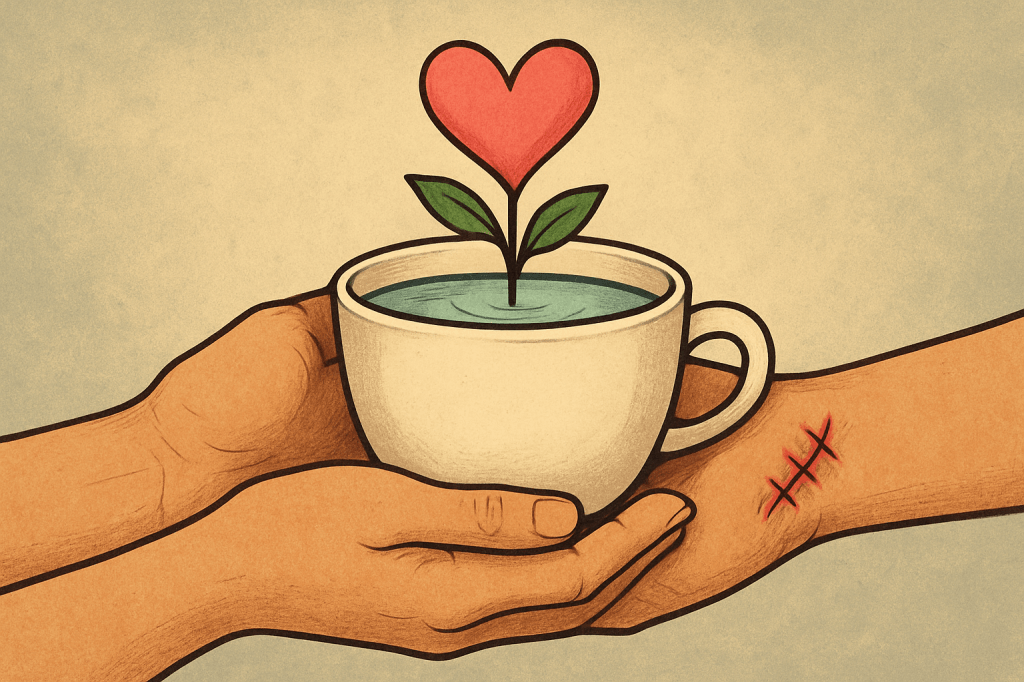
There’s a phrase you’ve probably seen floating around on social media, in self-help books, or printed in soft fonts over serene nature photos: “You can’t pour from an empty cup. You have to love yourself first.” It’s the kind of thing that sounds wise. Helpful, even. But is it true?
We’re told that if we don’t first learn to love ourselves, we’ll be incapable of offering genuine love to others. That if we don’t fill our own metaphorical cups to the brim, we’ll have nothing of value to give. It’s meant to be an encouragement to care for ourselves. But over time, this mantra has taken on a rigid moral tone. It suggests a hierarchy: first, self-love; then, love for others.
Let’s challenge that.
The Problem with the Cup
The “empty cup” metaphor assumes love is a finite resource—something you either have or don’t, something that must be measured and contained. But love isn’t like water. It’s not something that runs out just because we’re tired or sad or bruised by life. Love doesn’t have to originate from fullness. Sometimes it grows out of empathy, out of shared pain, out of the deep understanding that we know what it means to suffer.
Some of the most loving people in this world are the ones who struggle most with self-worth. People who hate their own reflection, who wrestle with depression or self-doubt, still manage to be kind, supportive, and fiercely devoted to others.
Why? Because love doesn’t always spring from joy. Sometimes it’s rooted in resilience.
Narcissism Isn’t the Goal
If loving yourself were the true prerequisite to loving others, we might expect the most self-confident among us to also be the kindest. But reality doesn’t bear that out.
Narcissists are case in point. They often exhibit an exaggerated self-love, a grandiose sense of self-importance, and yet they tend to lack empathy, manipulate those around them, and use others as tools for validation. Their love for themselves does not translate into care for anyone else.
So, if self-love doesn’t guarantee compassion, and self-loathing doesn’t prevent it, what does that say about the cup metaphor?
It says it’s broken.
Love Through the Cracks
Think of the people you know who give the most. The ones who bring soup when you’re sick. Who stay up too late on the phone when you’re heartbroken. Who remember the little things. How many of those people also quietly struggle with their own worth?
They don’t always have a full cup. Sometimes they feel like the cup is shattered. But they still show up. They give anyway. Because their love isn’t based on how worthy they feel. It’s based on how much they care.
We romanticize the idea of being whole before we connect with others. But wholeness is a moving target. And love isn’t a destination you arrive at once you’ve checked all the boxes of self-acceptance. It’s a journey. A messy, imperfect, deeply human one.
Love Isn’t a Transaction
Another problem with the self-love-first mindset is that it can turn love into a kind of transaction. “I will give love only if I have enough of it stored up.” But that’s not how real love works. Love isn’t a loan with interest. It isn’t something you tally up at the end of the day to make sure you didn’t give too much.
Real love is a risk. It’s a leap. It often comes from people who don’t feel whole but still choose to care. People who are grieving but still manage to be gentle. People who have been through hell and still smile at strangers.
That isn’t weakness. That’s strength.
The Courage of the Wounded
There’s a quiet heroism in the people who love from a place of pain. They aren’t waiting to be healed before they show compassion. They know suffering, and that’s precisely why they reach out. Because they understand. Because they see you.
Many of the most compassionate people in the world are the ones who have been broken. Who have felt discarded. Who know what it’s like to feel like they don’t matter. And because of that, they go out of their way to make sure others don’t feel the same.
Their love is not the product of self-love. It’s the product of empathy.
Love as a Practice
Rather than seeing love as a resource that flows only when we are full, what if we saw it as a practice? Like any practice, you can do it while you’re tired. While you’re unsure. While you’re healing.
Love is not a thing you have. It’s a thing you do.
And just like practice in music, or art, or meditation, you get better at it the more you do it. You don’t need to be perfect to begin. You just need to show up.
When you show love to others, even when you’re struggling, you aren’t being fake. You’re being generous. And sometimes, through that generosity, you end up learning how to extend that same care to yourself.
The Risk of Gatekeeping Love
Saying that people can’t love others unless they first love themselves risks silencing the voices of those who do love deeply, but haven’t yet figured out how to love themselves.
It can be invalidating. It can be cruel.
It suggests that love given from a “broken” place is somehow less real. Less valuable. Less meaningful.
But that’s not true. In fact, sometimes it’s more meaningful. Because it’s not coming from abundance. It’s coming from choice.
Rewriting the Script
Instead of telling people, “You have to love yourself first,” what if we said:
“You are capable of loving others, even if you don’t feel lovable yourself.“
“Your worth is not defined by how full your cup feels today.“
“It’s okay to be healing and loving at the same time.“
“You don’t have to be whole to be kind.“
This isn’t about glorifying suffering. It’s not a call to martyr yourself or ignore your own needs. Self-care is important. Rest is necessary. Boundaries are healthy.
But so is giving love when you can. Even when it hurts. Even when it’s hard.
Final Thoughts: The Reservoir Within
If love isn’t a cup, maybe it’s a reservoir. Deep, unseen, fed by many streams. Some of those streams are joy. Some are pain. Some are memory. Some are hope.
You don’t always get to control the flow. But the water is there. Waiting.
And sometimes, in giving love, you tap into a well you didn’t know you had.
So no, you don’t need to love yourself before you can love others.
Sometimes, it’s through loving others that you learn to finally see yourself as worthy of love too.
The Full Cup Fallacy: Why Love Doesn’t Wait on Self-Love
 Verideon
Leave a comment