I. Introduction
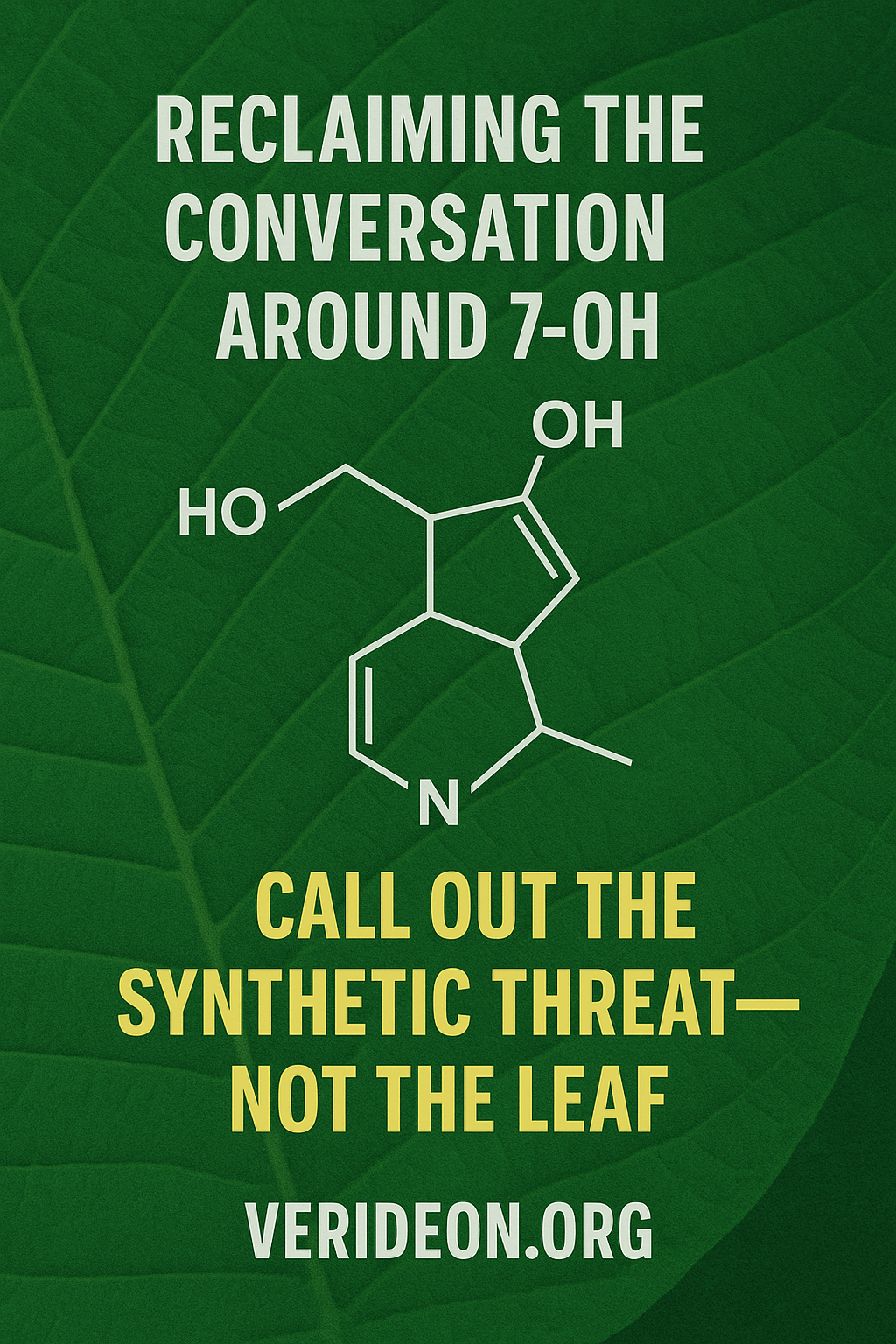
If you’ve spent more than five minutes in any online Kratom community lately, you’ve likely seen the same phrase recycled with increasing anxiety: “This product has 7-OH. Avoid it.” Or: “That vendor is putting 7-OH in their stuff. It’s dangerous.”
The negativity surrounding 7-hydroxymitragynine (7-OH) has reached a fever pitch, and unfortunately, most of it is based on misunderstanding rather than science. Somewhere along the line, the name of a naturally occurring compound in the Kratom plant became synonymous with danger, addiction, and synthetic tampering.
This article is here to challenge that narrative.
We aim to:
Clear up the confusion around 7-OH.
Highlight the difference between naturally occurring 7-OH and synthetic or adulterated versions.
Propose a new way for the Kratom community to talk about this alkaloid responsibly.
Because here’s the truth: all Kratom has 7-OH. If you’re using Kratom, you’re consuming 7-OH. The question isn’t whether 7-OH is present, but how it got there, and in what context.
II. What is 7-OH and Why It Exists
7-hydroxymitragynine is one of many alkaloids found in the Kratom plant (Mitragyna speciosa). Though it occurs in trace amounts in raw leaf (typically <0.01%), it plays an important role in Kratom’s effects.
When you consume Kratom, your liver converts a portion of mitragynine into 7-OH. This means the alkaloid isn’t just present in the plant — it’s a metabolite, part of the natural process your body uses to interact with the plant’s chemistry.
In this way, 7-OH isn’t some Frankenstein compound. It’s more like a translator between Kratom and your body’s receptors. It’s part of the plant’s fingerprint.
Removing 7-OH from Kratom is neither possible nor necessary. To hate 7-OH is to hate Kratom’s natural profile.
III. The Origin of the Stigma
The fear around 7-OH didn’t arise in a vacuum. It came in waves, shaped by misinformation, cherry-picked science, and bad actors in the industry.
Back in 2016, when the DEA first attempted to schedule Kratom, their primary justification rested on 7-OH. They claimed it was a powerful opioid, comparable to morphine. What they failed to note was:
The actual amount of 7-OH in raw leaf is minuscule.
Natural 7-OH works synergistically with dozens of other alkaloids, modulating its effects.
Later, certain vendors began selling highly potent, adulterated extracts that were sometimes spiked with synthetic 7-OH or other lab-made analogs. These products were not Kratom. They were dangerous, and they gave 7-OH a black eye it didn’t deserve.
IV. Natural vs Synthetic: Drawing the Line
To understand the problem, we have to get specific.
Natural 7-OH: Exists in the Kratom plant. Created by the liver from mitragynine. Present in raw leaf and full-spectrum extracts in trace amounts.
Synthetic 7-OH: Created in a lab. Added to products in unnaturally high concentrations. Often untested and sometimes mislabeled. This is what people are actually upset about.
The issue isn’t that 7-OH exists. The issue is when it is isolated, synthesized, and added back in without the rest of the plant’s balancing chemistry.
Imagine blaming caffeine for heart problems but not distinguishing between a cup of green tea and a bottle of synthetic caffeine pills. That’s what the Kratom community is doing to itself.
V. How the Kratom Community Got Trapped by the Terminology
Here’s the kicker: even many well-meaning advocates are helping spread this confusion.
When people say things like:
“This product has 7-OH, so it’s dangerous”
“That vendor adds 7-OH to their Kratom”
“We only sell products with no 7-OH”
…they’re inadvertently helping the narrative that 7-OH itself is the problem. They’re teaching consumers to fear an alkaloid that has always been present in the plant.
This is what prohibitionists want. They want the conversation to be about scary-sounding chemicals instead of real science. They want our own community to do their work for them.
VI. Proposing New Language for the Kratom Space
It’s time to reframe the conversation.
We need to reserve our criticism for synthetic or adulterated 7-OH — and we need language that reflects that. Here are some suggestions:
Synthetic Isolate 7-OH: Clearly separates lab-made versions from natural ones.
Lab-Spiked 7-OH: Flags products that have been tampered with.
7-OH Additive: A red flag term that implies unnatural concentration.
Adulterated 7-OH: Implies deviation from full-spectrum leaf.
At the same time, we should start affirming when 7-OH is present in a natural context:
“This is a raw leaf product. Trace 7-OH is naturally occurring.”
“This extract uses a full-spectrum process. No isolated alkaloids added.”
Precision in language protects the plant.
VII. Why This Matters Now More Than Ever
We are at a turning point. Legislatures across the U.S. are introducing Kratom bans, often citing fears over 7-OH. If we allow the current language to persist, we are giving prohibitionists all the ammunition they need.
The FDA has already exploited this confusion in their propaganda. Their talking points rely on the conflation between synthetic and natural. If we don’t correct the record, who will?
Worse, we risk alienating new consumers who are trying to educate themselves. When every online post screams “7-OH = BAD,” they miss out on the nuance. They might even turn to riskier substances instead.
VIII. The Path Forward
Here’s what needs to happen:
Vendors must stop marketing products with vague or misleading claims like “no 7-OH.” Be specific. Be transparent. Label full-spectrum extracts clearly.
Consumers must demand clarity. Ask vendors whether their products use isolated alkaloids. Support companies that provide third-party testing and real education.
Influencers and advocates need to model better language. Instead of fear-mongering, help people understand the difference between plant and poison.
Researchers and scientists should continue exploring the natural synergy of alkaloids in Kratom. We need peer-reviewed studies to reinforce what we already know: the leaf is not the problem.
IX. Conclusion
7-OH is not the villain. It’s the scapegoat.
Let’s stop letting prohibitionists define our narrative. Let’s stop sabotaging our own community by parroting their fear-based framing.
Instead, let’s get smart, get unified, and speak with clarity. We protect the plant when we tell the truth about it.
There is no Kratom without 7-OH. But there can be Kratom without fear.
Let’s make that the new standard.
Category: The Mitragynist
-
Reclaiming 7-OH: Ending the Demonization of Kratom’s Most Misunderstood Alkaloid
-
The Full Cup Fallacy: Why Love Doesn’t Wait on Self-Love
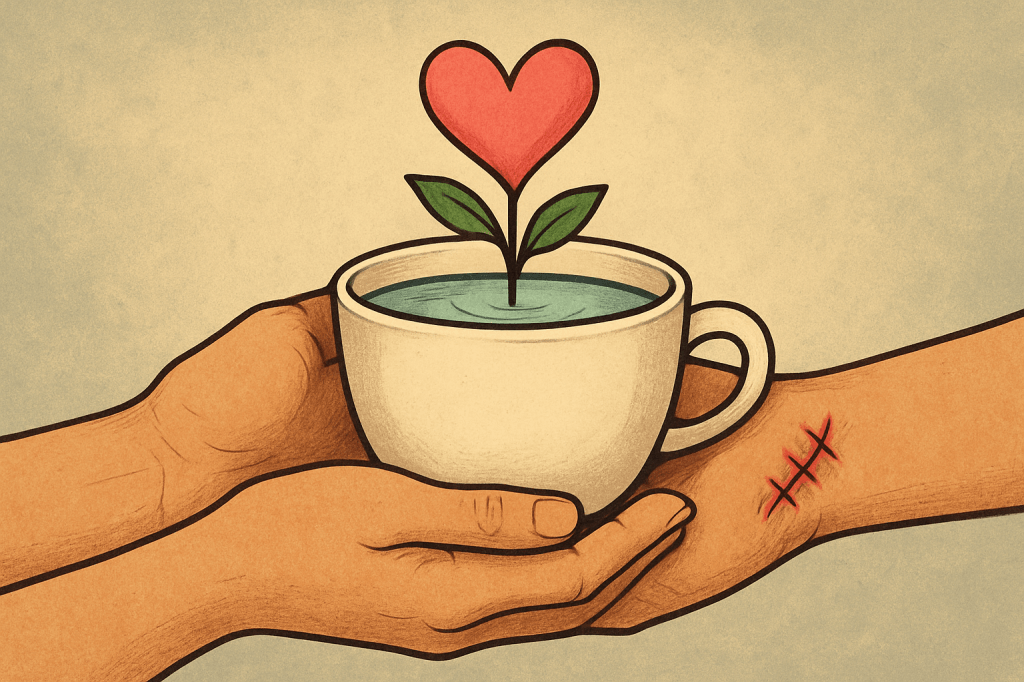
There’s a phrase you’ve probably seen floating around on social media, in self-help books, or printed in soft fonts over serene nature photos: “You can’t pour from an empty cup. You have to love yourself first.” It’s the kind of thing that sounds wise. Helpful, even. But is it true?
We’re told that if we don’t first learn to love ourselves, we’ll be incapable of offering genuine love to others. That if we don’t fill our own metaphorical cups to the brim, we’ll have nothing of value to give. It’s meant to be an encouragement to care for ourselves. But over time, this mantra has taken on a rigid moral tone. It suggests a hierarchy: first, self-love; then, love for others.
Let’s challenge that.
The Problem with the Cup
The “empty cup” metaphor assumes love is a finite resource—something you either have or don’t, something that must be measured and contained. But love isn’t like water. It’s not something that runs out just because we’re tired or sad or bruised by life. Love doesn’t have to originate from fullness. Sometimes it grows out of empathy, out of shared pain, out of the deep understanding that we know what it means to suffer.
Some of the most loving people in this world are the ones who struggle most with self-worth. People who hate their own reflection, who wrestle with depression or self-doubt, still manage to be kind, supportive, and fiercely devoted to others.
Why? Because love doesn’t always spring from joy. Sometimes it’s rooted in resilience.
Narcissism Isn’t the Goal
If loving yourself were the true prerequisite to loving others, we might expect the most self-confident among us to also be the kindest. But reality doesn’t bear that out.
Narcissists are case in point. They often exhibit an exaggerated self-love, a grandiose sense of self-importance, and yet they tend to lack empathy, manipulate those around them, and use others as tools for validation. Their love for themselves does not translate into care for anyone else.
So, if self-love doesn’t guarantee compassion, and self-loathing doesn’t prevent it, what does that say about the cup metaphor?
It says it’s broken.
Love Through the Cracks
Think of the people you know who give the most. The ones who bring soup when you’re sick. Who stay up too late on the phone when you’re heartbroken. Who remember the little things. How many of those people also quietly struggle with their own worth?
They don’t always have a full cup. Sometimes they feel like the cup is shattered. But they still show up. They give anyway. Because their love isn’t based on how worthy they feel. It’s based on how much they care.
We romanticize the idea of being whole before we connect with others. But wholeness is a moving target. And love isn’t a destination you arrive at once you’ve checked all the boxes of self-acceptance. It’s a journey. A messy, imperfect, deeply human one.
Love Isn’t a Transaction
Another problem with the self-love-first mindset is that it can turn love into a kind of transaction. “I will give love only if I have enough of it stored up.” But that’s not how real love works. Love isn’t a loan with interest. It isn’t something you tally up at the end of the day to make sure you didn’t give too much.
Real love is a risk. It’s a leap. It often comes from people who don’t feel whole but still choose to care. People who are grieving but still manage to be gentle. People who have been through hell and still smile at strangers.
That isn’t weakness. That’s strength.
The Courage of the Wounded
There’s a quiet heroism in the people who love from a place of pain. They aren’t waiting to be healed before they show compassion. They know suffering, and that’s precisely why they reach out. Because they understand. Because they see you.
Many of the most compassionate people in the world are the ones who have been broken. Who have felt discarded. Who know what it’s like to feel like they don’t matter. And because of that, they go out of their way to make sure others don’t feel the same.
Their love is not the product of self-love. It’s the product of empathy.
Love as a Practice
Rather than seeing love as a resource that flows only when we are full, what if we saw it as a practice? Like any practice, you can do it while you’re tired. While you’re unsure. While you’re healing.
Love is not a thing you have. It’s a thing you do.
And just like practice in music, or art, or meditation, you get better at it the more you do it. You don’t need to be perfect to begin. You just need to show up.
When you show love to others, even when you’re struggling, you aren’t being fake. You’re being generous. And sometimes, through that generosity, you end up learning how to extend that same care to yourself.
The Risk of Gatekeeping Love
Saying that people can’t love others unless they first love themselves risks silencing the voices of those who do love deeply, but haven’t yet figured out how to love themselves.
It can be invalidating. It can be cruel.
It suggests that love given from a “broken” place is somehow less real. Less valuable. Less meaningful.
But that’s not true. In fact, sometimes it’s more meaningful. Because it’s not coming from abundance. It’s coming from choice.
Rewriting the Script
Instead of telling people, “You have to love yourself first,” what if we said:
“You are capable of loving others, even if you don’t feel lovable yourself.“
“Your worth is not defined by how full your cup feels today.“
“It’s okay to be healing and loving at the same time.“
“You don’t have to be whole to be kind.“
This isn’t about glorifying suffering. It’s not a call to martyr yourself or ignore your own needs. Self-care is important. Rest is necessary. Boundaries are healthy.
But so is giving love when you can. Even when it hurts. Even when it’s hard.
Final Thoughts: The Reservoir Within
If love isn’t a cup, maybe it’s a reservoir. Deep, unseen, fed by many streams. Some of those streams are joy. Some are pain. Some are memory. Some are hope.
You don’t always get to control the flow. But the water is there. Waiting.
And sometimes, in giving love, you tap into a well you didn’t know you had.
So no, you don’t need to love yourself before you can love others.
Sometimes, it’s through loving others that you learn to finally see yourself as worthy of love too. -

May is the Final Bloom
Spring always starts with promises. Promises of growth, renewal, warmth, and light. And every year, we tell ourselves this is the season we’ll finally slow down. Breathe more. Let go of the heavy things we’ve been dragging through winter.
But by the time May rolls in, something shifts. The air is thicker. The flowers aren’t just budding—they’re in full bloom. The birds aren’t just returning—they’re nesting. Life isn’t just waking up anymore—it’s moving forward. And it’s a quiet reminder: spring doesn’t last forever. The time to begin is now.
In the leaf community, many of us know what it means to start over. Whether it’s recovering from illness, stepping away from toxic systems, breaking old habits, or simply reclaiming control of our own bodies—new beginnings aren’t abstract to us. They’re survival. They’re sacred.
And yet, even sacred things can be slow. Healing doesn’t always feel like blooming. Some days it feels like dragging your roots through stone. Other days it feels like sitting in the sun and wondering if it’s okay to feel good. May reminds us that both are valid. Both are part of the process.
So if you’re just now finding your footing—welcome. You’re not late. If you’re changing your direction—go with grace. And if you’re tired, even as the world wakes up—rest. Because May isn’t a deadline. It’s a launchpad. It’s the soft push that says, “You don’t have to be ready. You just have to begin.”
Let this be the month you plant something new—even if it’s just a thought. Let it be the time you forgive yourself, just a little more than yesterday. Let it be the moment you say, “I’m not who I was, and that’s a good thing.”
Because spring is a season of beginning.
And May? May is the moment we become. -

Three May Milestones That Shaped the Herbal Movement
Every movement has its turning points—those moments where the arc of history bends ever so slightly toward progress. For those of us who believe in bodily autonomy and the right to choose natural paths to wellness, May has delivered more than a few of these pivotal events. In this piece, we reflect on three such milestones: the passage of the Dietary Supplement Health and Education Act in 1994, the grassroots uprising against the DEA’s 2016 Kratom scheduling attempt, and Thailand’s historic decriminalization of Kratom in 2021.
1. May 1994: The DSHEA and the Battle for Access
Before the internet made herbal information widely accessible, the 1990s were a battleground for access and awareness. In May 1994, the U.S. Congress passed the Dietary Supplement Health and Education Act (DSHEA), fundamentally changing the way herbs, vitamins, and supplements were regulated in America. This law placed herbal products like Kratom and Kava into the category of “dietary supplements,” sparing them from the strict pre-market approval process required for pharmaceutical drugs.
DSHEA empowered consumers and created a space for thousands of small producers to flourish. While not without its flaws, it marked the first time the federal government formally acknowledged that people had a right to access natural products without needing a doctor’s permission. For Kratom advocates, DSHEA created the legal foundation that still supports market access today.
2. May 2016: The People Push Back
In May 2016, the DEA quietly moved to place Kratom’s primary alkaloids, mitragynine and 7-hydroxymitragynine, into Schedule I—effectively banning the plant nationwide. The reasoning was thin, the science incomplete, and the backlash immediate.
What followed was a landmark moment for grassroots advocacy. Scientists, consumers, veterans, chronic pain patients, and parents of recovering addicts came together in unprecedented numbers. They submitted over 23,000 public comments, flooded congressional offices with calls and letters, and organized rallies across the country.
By October 2016, the DEA withdrew its notice of intent—a rare and stunning reversal. That pushback marked one of the clearest examples in modern history of people demanding the right to make their own health decisions, and actually winning.
3. May 2021: Thailand Reclaims Its Herbal Legacy
Thailand has used Kratom for centuries, but colonial-era laws and the global drug war had outlawed its use for decades. In May 2021, that changed. Thailand officially removed Kratom from its list of controlled substances, legalizing cultivation, possession, and use.
This move wasn’t just symbolic. It opened the door for regulated domestic use, scientific research, and even export. Most importantly, it recognized the legitimacy of traditional, community-based herbal knowledge. By decriminalizing Kratom, Thailand took a stand not just for cultural heritage but for modern harm reduction.
A Month of Milestones
May may not hold a federal holiday for herbal freedom—yet—but its history is already rich with examples of progress. These three moments show how change can come through legislation, resistance, and reclamation. They also remind us that the fight for herbal access is ongoing.
As we continue to face misinformation, stigma, and attempts at prohibition, it helps to remember: we’ve pushed back before. We can do it again.
Stay grounded. Stay free. And always, stay informed.
The Mitragynist is a voice for plant autonomy, people-powered health, and honest conversation. If you have a favorite moment in herbal history, let us know—we may feature it in an upcoming edition. -

Halfway Through: A Midweek Reminder for the Rest of Us
Somewhere between “Just five more minutes” and “Where did the week go?” we find ourselves staring down the back half of another week. Maybe your Monday came in like a wrecking ball. Maybe Tuesday showed up with unexpected grace. Maybe you’re just here, trying to catch your breath between obligations, emotions, and that constant low hum of everything.
So, take a moment. Right here. Right now.
This is not a motivational speech about hustling harder or chasing dreams until you collapse. This is a reminder: You’re allowed to exist without performing. You’re allowed to move slowly. To sip your coffee while it’s hot. To look out the window and not feel guilty for pausing.
You’ve made it halfway. And that’s not nothing.
It’s easy to overlook progress when the world demands fireworks just for you to feel accomplished. But the real magic? It’s in the subtle. The quiet. The consistent. Showing up, even when you don’t feel like it. Getting out of bed when your soul is heavy. Answering the text. Feeding the dog. Caring for the people you love even when you’re running on fumes.
If you need a sign to slow down, this is it.
If you need permission to rest, you have it.
If you’re feeling behind, you’re not.
You’re exactly where you are supposed to be—learning, adapting, becoming.
We’re not here to tell you how to live. But we are here to remind you: Your effort is valid. Your exhaustion is not weakness. And your worth is not tied to productivity.
Let the rest of the week unfold as it will. You don’t have to conquer it. You just have to meet it with grace, and maybe a little caffeine.
We’ll be right here, rooting for you. -

Synthetic Imitations, Real Risks: What You Need to Know About Semi-Synthetic 7-OH Products
Not all “Kratom” is what it claims to be.
In early 2025, a research team including Dr. Christopher McCurdy—one of the most respected scientists in the Kratom field—published a warning in the journal Addiction about a rising threat to consumer safety: the emergence of semi-synthetic 7-hydroxymitragynine (7-OH) products being sold under the Kratom name.
What’s the Big Deal?
Naturally, 7-OH exists in Kratom in very small amounts. It’s one of the plant’s most potent alkaloids, with 14 to 22 times the mu-opioid receptor binding affinity of morphine. But in its natural form—alongside over 40 other alkaloids—it’s balanced by nature.
These new products?
They’re not balanced. They’re engineered.
What’s Being Sold?
Researchers identified novel products like:
Sublingual tablets
Nasal sprays
Capsules containing up to 98% 7-OH
Some single doses contain 14–25mg of pure 7-OH—compared to the micrograms present in natural Kratom. And with delivery methods that bypass digestion, they hit harder, faster, and more unpredictably.
Why Should You Care?
Because these products are being sold under the Kratom label.
That means people might think they’re taking regular, leaf-based Kratom—when in reality, they’re consuming something far more potent, far less studied, and potentially dangerous.
The authors of the study highlighted several serious concerns:
High potential for abuse and dependency
No human or animal safety data
No labeling or consumer warning
Regulatory confusion and gray market risks
This Isn’t Traditional Kratom
This isn’t the cup of tea many people rely on for managing chronic pain, stress, or focus. This is chemistry that mimics one part of Kratom while removing the balance that nature built.
The danger here isn’t just about the synthetic alkaloids—it’s about misleading consumers, damaging public trust, and handing fuel to those who want Kratom banned altogether.
Verideon’s Stance
We believe in transparency, education, and safe, natural products. We don’t support the sale or promotion of semi-synthetic 7-OH disguised as “Kratom.” Consumers have a right to know what they’re putting in their bodies—and to choose whole-plant products that have centuries of traditional use behind them, not mystery compounds with no safety data.
If you want to read the original study, here it is:
The Rise of Novel, Semi-Synthetic 7-Hydroxymitragynine Products
This is your leaf, your choice. Let’s keep it that way—by staying informed, speaking up, and holding companies accountable for the truth. -
It’s Friday. The leaves are steeping. And you’re still standing.
That’s no small thing.
Some of you crushed this week.
Some of you barely crawled through it with a mug in one hand and your last nerve in the other.
Either way—you made it.
That counts.
Whether you’re clocking out, still grinding, or wondering how it’s somehow already Friday again, take a second to breathe.
Slow down.
Sip something warm.
You deserve a little softness. A little stillness.
Even if the week wasn’t perfect.
Even if you weren’t perfect.
That daily cup—the ritual, the pause, the inhale before the next inhale—it’s not just habit. It’s a kind of quiet resilience.
It’s saying,
“I showed up.”
“I kept going.”
“I did the best I could.”
And honestly? That’s enough.
And to those who start their workweek today—yeah, we see you too.
While everyone’s shouting “TGIF,” you’re lacing up, showing up, and doing what needs to be done.
You’re the quiet backbone of this world’s weird rhythm. And we’re rooting for you, too.
Here’s to you.
Here’s to rest—whenever you get it.
Here’s to Friday.
And here’s to the next leaf. -

To the Graduates. The Survivors. The Not-Yet-There-But-Trying.
The semester has ended, and across the country, people are catching their breath.
Some of you crossed the stage.
Some of you crossed your fingers.
Some of you just crossed days off the calendar and said, “I made it through.”
To the graduates:
Congratulations. You held the line. You followed through. You earned the right to rest—and to celebrate. Even if you’re still unsure what comes next, you did something big. And that matters.
To the ones who didn’t hit every goal this time around:
You’re still in this. Progress isn’t always a straight line. Sometimes it’s messy, exhausting, and slow—but it’s still progress.
You don’t need a tassel to prove your growth. Just waking up and trying again is an act of quiet resilience.
To the ones unsure if you’ll return next semester:
Take the breath you need. Rest isn’t failure. And your path doesn’t have to look like anyone else’s. The world needs people who move at their own pace, with their own purpose.
This moment—this transition—it’s not the end.
It’s just a comma.
A breath between chapters.
Whether you finished with honors or barely finished at all…
Whether your next step is grad school, a job, a nap, or no idea—
You’re still writing your story.
And you’re doing a damn good job.
So here’s to the ones who made it.
And to the ones who will.
You’re not alone in this. And you’re not behind.
You’re becoming. -

To the Sleep-Deprived, the Almost-There, and the Newly Crowned Graduates—We See You.
The semester is closing.
Textbooks are slamming shut. Finals are over. Coffee cups are empty. Tea mugs? Still half-full—because hope runs deep.
Whether you just walked across a stage in cap and gown…
Or barely crawled across the finish line with a B-minus and a nervous twitch—you made it.
And that matters.
Here at The Mitragynist, we raise our cups to you.
To the late-night note-crammers, the essay warriors, the group project survivors.
To the ones who brewed the leaf at midnight and whispered, “just one more hour.”
To those who didn’t finish this time—but will next time.
You’re part of this, too.
Kratom isn’t a shortcut.
It’s a companion.
It’s the little bit of calm in a swirling storm.
It’s the reason some of you made it through 18 credit hours, two part-time jobs, and still remembered to eat… occasionally.
This journey isn’t about perfection. It’s about persistence.
Leaf by leaf. Page by page. Step by step.
And if you’re here—still trying, still learning, still waking up and showing up—then you’re doing it right.
Celebrate what you’ve done.
Forgive what you couldn’t.
And no matter what—keep going.
The world needs people like you.
People who keep pushing.
People who care enough to keep growing.
Take a breath. Sip something green. You’ve earned it. -

Digestive Drama and Botanical Bliss
Let’s Talk About Kratom and Pooping (Because Somebody Has To)
Look, we all love the leaf. It’s calm in the chaos. It’s relief in a cup. It’s focus, or peace, or “finally, I can function today.”
But let’s not pretend there’s not a shadow side to this herbal hero.
We’re talking about…
The Kratom Poops.
Or more accurately: The Lack Thereof.
If you’ve found yourself staring into the middle distance, wondering if your digestive system has been put on indefinite furlough—congrats. You’re not broken. You’re just backed up by botanicals.
Here’s the deal:
Kratom’s primary alkaloids—mitragynine and 7-hydroxymitragynine—bind to the same opioid receptors that prescription pain meds do. And just like their pharmaceutical cousins, they can slow your gut way down.
So what can you do to get back on track?
Tip #1: Hydrate Like You Mean It
Drinking plenty of non-alcoholic liquids is your first line of defense. Kratom’s natural dehydrating effect can dry you out faster than your ex at a dinner party. Water, herbal tea, electrolyte drinks—drink them all. Your colon will thank you.
Tip #2: Embrace the Power of the Poop Knife
Yes. It’s real. No, we didn’t invent it. If you know, you know. And if you don’t… well, let’s just say: sometimes, you need to call in the heavy artillery. It’s not glamorous. But it gets the job done.
Bonus Tips:
Add magnesium citrate to your routine. It helps move things along without being harsh.
Eat real food with fiber. Like fruit. Or actual vegetables. (We know, wild concept.)
Take breaks. Your system needs a breather too.
Kratom isn’t the enemy—being unprepared is.
So take care of your gut, hydrate like a champ, and maybe keep a Poop Knife on standby.
Because you deserve regularity.
You deserve movement.
You deserve… a stress-free #2.
 Verideon