Today is July 4th—America’s birthday. Fireworks, parades, speeches, flags. We sing songs about liberty, we quote the Founders, we raise a toast to the idea that this country was built on freedom.
But how much freedom do we really have?
You can’t talk about liberty without talking about autonomy. Not just political autonomy, but bodily autonomy. That’s supposed to be sacred in a free nation. The right to live your life, to make decisions about your own body, your own health, and your own future—without needing permission from some bureaucrat or politician.
But the truth is, that kind of freedom is under siege.
Look at what’s happening across the country with Kratom. Or CBD. Or any plant that dares to give people relief outside of a prescription bottle.
These aren’t dangerous street drugs. They’re not synthetic lab poisons. These are natural tools—gifts, some would say—that have helped millions of Americans manage pain, anxiety, withdrawal, and more. And yet, states and federal agencies are trying to ban them. Regulate them into oblivion. Punish people for making their own choices.
All while opioid manufacturers walk away from one of the deadliest drug epidemics in human history with fines that barely scratch their profits.
You want to talk about freedom? Let’s talk about that.
Let’s talk about veterans who fought for this country only to come home and be told that the only legal pain relief they’re allowed is highly addictive, highly profitable, and often ineffective. Let’s talk about mothers with chronic conditions who find peace in a plant—only to have it taken away by a statehouse full of people who don’t even understand how it works.
Let’s talk about the word independence, and how it rings hollow if it doesn’t include independence of the mind, body, and spirit.
Kratom isn’t just a leaf. CBD isn’t just an oil. These are lifelines. And the people who rely on them aren’t criminals—they’re human beings exercising the most basic kind of liberty: the right to feel better, without asking for permission.
But somehow, that’s become a radical act.
So today, while we’re told to be grateful for our freedom, some of us are wondering: Freedom for who? And freedom to do what, exactly? Because it seems like every time a natural solution gains popularity—every time the people take health into their own hands—there’s a new push to outlaw it.
Maybe the truth is, freedom has always been conditional.
Conditional on money. On lobbyists. On politics. On which industries get protected and which ones get crushed.
But we’re not giving up. Because we believe that true liberty means something more than slogans on T-shirts and fireworks in the sky. It means something personal. Something human. It means standing up when the government tells you that your health doesn’t belong to you anymore.
Today, we don’t just celebrate independence—we demand it. For every person who has been helped by the leaf. For every family who found hope in a bottle of CBD. For every soul who decided that healing shouldn’t come with handcuffs.
This is our revolution. Quiet, maybe—but growing louder every day.
And we won’t stop until freedom means what it was always supposed to mean:
The right to choose what you put in your body.
The right to manage your own pain.
The right to thrive—without fear.
Because if that’s not worth fighting for, what is?
Blog
-
Independence, But Not for Everyone
-
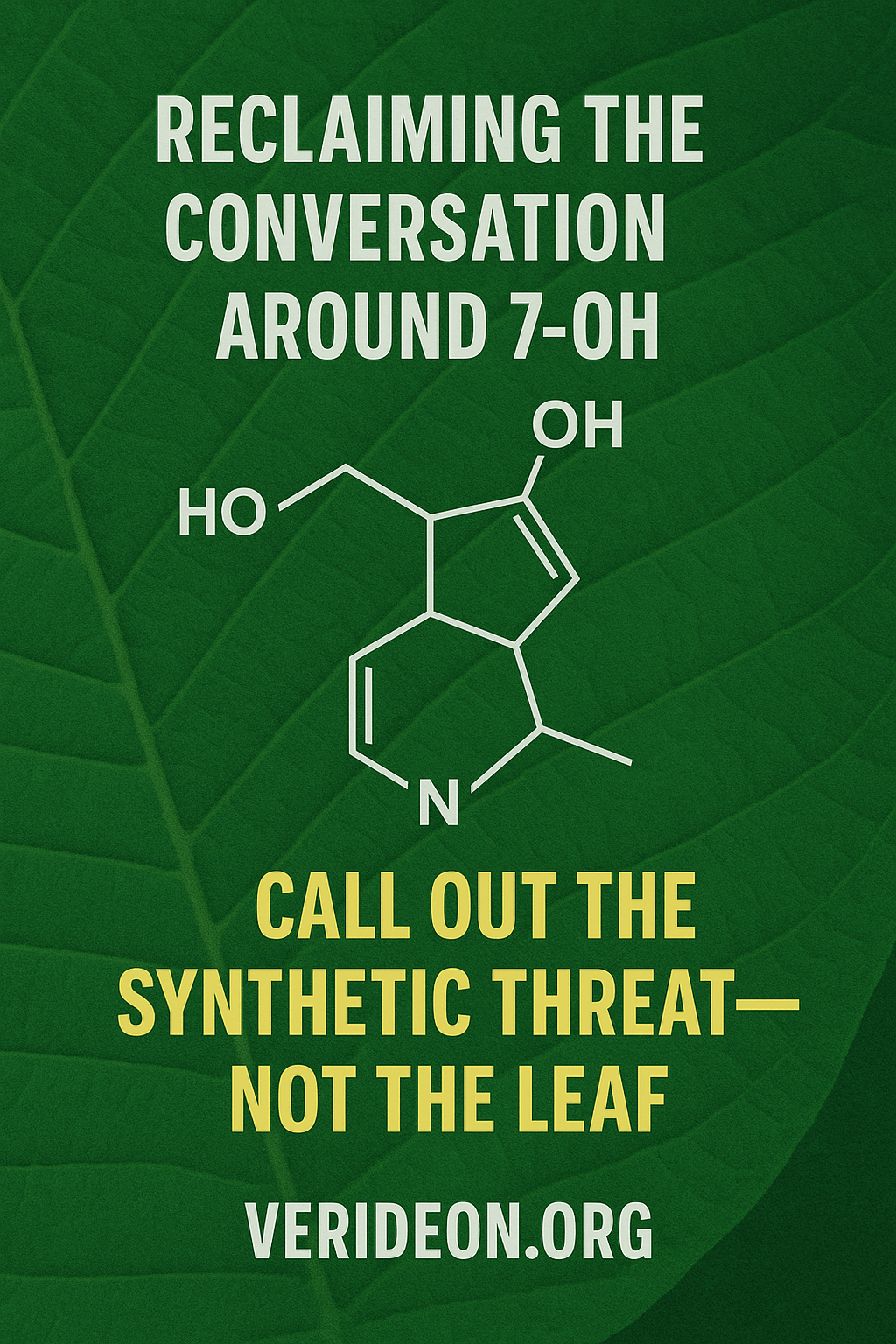
Reclaiming 7-OH: Ending the Demonization of Kratom’s Most Misunderstood Alkaloid
I. Introduction
If you’ve spent more than five minutes in any online Kratom community lately, you’ve likely seen the same phrase recycled with increasing anxiety: “This product has 7-OH. Avoid it.” Or: “That vendor is putting 7-OH in their stuff. It’s dangerous.”
The negativity surrounding 7-hydroxymitragynine (7-OH) has reached a fever pitch, and unfortunately, most of it is based on misunderstanding rather than science. Somewhere along the line, the name of a naturally occurring compound in the Kratom plant became synonymous with danger, addiction, and synthetic tampering.
This article is here to challenge that narrative.
We aim to:
Clear up the confusion around 7-OH.
Highlight the difference between naturally occurring 7-OH and synthetic or adulterated versions.
Propose a new way for the Kratom community to talk about this alkaloid responsibly.
Because here’s the truth: all Kratom has 7-OH. If you’re using Kratom, you’re consuming 7-OH. The question isn’t whether 7-OH is present, but how it got there, and in what context.
II. What is 7-OH and Why It Exists
7-hydroxymitragynine is one of many alkaloids found in the Kratom plant (Mitragyna speciosa). Though it occurs in trace amounts in raw leaf (typically <0.01%), it plays an important role in Kratom’s effects.
When you consume Kratom, your liver converts a portion of mitragynine into 7-OH. This means the alkaloid isn’t just present in the plant — it’s a metabolite, part of the natural process your body uses to interact with the plant’s chemistry.
In this way, 7-OH isn’t some Frankenstein compound. It’s more like a translator between Kratom and your body’s receptors. It’s part of the plant’s fingerprint.
Removing 7-OH from Kratom is neither possible nor necessary. To hate 7-OH is to hate Kratom’s natural profile.
III. The Origin of the Stigma
The fear around 7-OH didn’t arise in a vacuum. It came in waves, shaped by misinformation, cherry-picked science, and bad actors in the industry.
Back in 2016, when the DEA first attempted to schedule Kratom, their primary justification rested on 7-OH. They claimed it was a powerful opioid, comparable to morphine. What they failed to note was:
The actual amount of 7-OH in raw leaf is minuscule.
Natural 7-OH works synergistically with dozens of other alkaloids, modulating its effects.
Later, certain vendors began selling highly potent, adulterated extracts that were sometimes spiked with synthetic 7-OH or other lab-made analogs. These products were not Kratom. They were dangerous, and they gave 7-OH a black eye it didn’t deserve.
IV. Natural vs Synthetic: Drawing the Line
To understand the problem, we have to get specific.
Natural 7-OH: Exists in the Kratom plant. Created by the liver from mitragynine. Present in raw leaf and full-spectrum extracts in trace amounts.
Synthetic 7-OH: Created in a lab. Added to products in unnaturally high concentrations. Often untested and sometimes mislabeled. This is what people are actually upset about.
The issue isn’t that 7-OH exists. The issue is when it is isolated, synthesized, and added back in without the rest of the plant’s balancing chemistry.
Imagine blaming caffeine for heart problems but not distinguishing between a cup of green tea and a bottle of synthetic caffeine pills. That’s what the Kratom community is doing to itself.
V. How the Kratom Community Got Trapped by the Terminology
Here’s the kicker: even many well-meaning advocates are helping spread this confusion.
When people say things like:
“This product has 7-OH, so it’s dangerous”
“That vendor adds 7-OH to their Kratom”
“We only sell products with no 7-OH”
…they’re inadvertently helping the narrative that 7-OH itself is the problem. They’re teaching consumers to fear an alkaloid that has always been present in the plant.
This is what prohibitionists want. They want the conversation to be about scary-sounding chemicals instead of real science. They want our own community to do their work for them.
VI. Proposing New Language for the Kratom Space
It’s time to reframe the conversation.
We need to reserve our criticism for synthetic or adulterated 7-OH — and we need language that reflects that. Here are some suggestions:
Synthetic Isolate 7-OH: Clearly separates lab-made versions from natural ones.
Lab-Spiked 7-OH: Flags products that have been tampered with.
7-OH Additive: A red flag term that implies unnatural concentration.
Adulterated 7-OH: Implies deviation from full-spectrum leaf.
At the same time, we should start affirming when 7-OH is present in a natural context:
“This is a raw leaf product. Trace 7-OH is naturally occurring.”
“This extract uses a full-spectrum process. No isolated alkaloids added.”
Precision in language protects the plant.
VII. Why This Matters Now More Than Ever
We are at a turning point. Legislatures across the U.S. are introducing Kratom bans, often citing fears over 7-OH. If we allow the current language to persist, we are giving prohibitionists all the ammunition they need.
The FDA has already exploited this confusion in their propaganda. Their talking points rely on the conflation between synthetic and natural. If we don’t correct the record, who will?
Worse, we risk alienating new consumers who are trying to educate themselves. When every online post screams “7-OH = BAD,” they miss out on the nuance. They might even turn to riskier substances instead.
VIII. The Path Forward
Here’s what needs to happen:
Vendors must stop marketing products with vague or misleading claims like “no 7-OH.” Be specific. Be transparent. Label full-spectrum extracts clearly.
Consumers must demand clarity. Ask vendors whether their products use isolated alkaloids. Support companies that provide third-party testing and real education.
Influencers and advocates need to model better language. Instead of fear-mongering, help people understand the difference between plant and poison.
Researchers and scientists should continue exploring the natural synergy of alkaloids in Kratom. We need peer-reviewed studies to reinforce what we already know: the leaf is not the problem.
IX. Conclusion
7-OH is not the villain. It’s the scapegoat.
Let’s stop letting prohibitionists define our narrative. Let’s stop sabotaging our own community by parroting their fear-based framing.
Instead, let’s get smart, get unified, and speak with clarity. We protect the plant when we tell the truth about it.
There is no Kratom without 7-OH. But there can be Kratom without fear.
Let’s make that the new standard. -
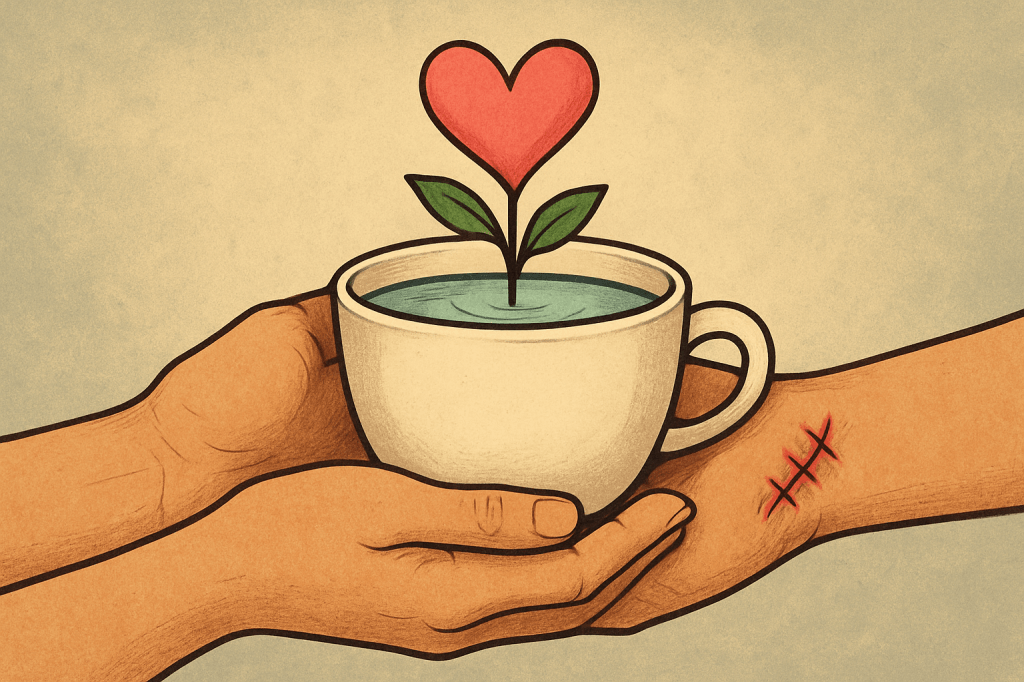
The Full Cup Fallacy: Why Love Doesn’t Wait on Self-Love
There’s a phrase you’ve probably seen floating around on social media, in self-help books, or printed in soft fonts over serene nature photos: “You can’t pour from an empty cup. You have to love yourself first.” It’s the kind of thing that sounds wise. Helpful, even. But is it true?
We’re told that if we don’t first learn to love ourselves, we’ll be incapable of offering genuine love to others. That if we don’t fill our own metaphorical cups to the brim, we’ll have nothing of value to give. It’s meant to be an encouragement to care for ourselves. But over time, this mantra has taken on a rigid moral tone. It suggests a hierarchy: first, self-love; then, love for others.
Let’s challenge that.
The Problem with the Cup
The “empty cup” metaphor assumes love is a finite resource—something you either have or don’t, something that must be measured and contained. But love isn’t like water. It’s not something that runs out just because we’re tired or sad or bruised by life. Love doesn’t have to originate from fullness. Sometimes it grows out of empathy, out of shared pain, out of the deep understanding that we know what it means to suffer.
Some of the most loving people in this world are the ones who struggle most with self-worth. People who hate their own reflection, who wrestle with depression or self-doubt, still manage to be kind, supportive, and fiercely devoted to others.
Why? Because love doesn’t always spring from joy. Sometimes it’s rooted in resilience.
Narcissism Isn’t the Goal
If loving yourself were the true prerequisite to loving others, we might expect the most self-confident among us to also be the kindest. But reality doesn’t bear that out.
Narcissists are case in point. They often exhibit an exaggerated self-love, a grandiose sense of self-importance, and yet they tend to lack empathy, manipulate those around them, and use others as tools for validation. Their love for themselves does not translate into care for anyone else.
So, if self-love doesn’t guarantee compassion, and self-loathing doesn’t prevent it, what does that say about the cup metaphor?
It says it’s broken.
Love Through the Cracks
Think of the people you know who give the most. The ones who bring soup when you’re sick. Who stay up too late on the phone when you’re heartbroken. Who remember the little things. How many of those people also quietly struggle with their own worth?
They don’t always have a full cup. Sometimes they feel like the cup is shattered. But they still show up. They give anyway. Because their love isn’t based on how worthy they feel. It’s based on how much they care.
We romanticize the idea of being whole before we connect with others. But wholeness is a moving target. And love isn’t a destination you arrive at once you’ve checked all the boxes of self-acceptance. It’s a journey. A messy, imperfect, deeply human one.
Love Isn’t a Transaction
Another problem with the self-love-first mindset is that it can turn love into a kind of transaction. “I will give love only if I have enough of it stored up.” But that’s not how real love works. Love isn’t a loan with interest. It isn’t something you tally up at the end of the day to make sure you didn’t give too much.
Real love is a risk. It’s a leap. It often comes from people who don’t feel whole but still choose to care. People who are grieving but still manage to be gentle. People who have been through hell and still smile at strangers.
That isn’t weakness. That’s strength.
The Courage of the Wounded
There’s a quiet heroism in the people who love from a place of pain. They aren’t waiting to be healed before they show compassion. They know suffering, and that’s precisely why they reach out. Because they understand. Because they see you.
Many of the most compassionate people in the world are the ones who have been broken. Who have felt discarded. Who know what it’s like to feel like they don’t matter. And because of that, they go out of their way to make sure others don’t feel the same.
Their love is not the product of self-love. It’s the product of empathy.
Love as a Practice
Rather than seeing love as a resource that flows only when we are full, what if we saw it as a practice? Like any practice, you can do it while you’re tired. While you’re unsure. While you’re healing.
Love is not a thing you have. It’s a thing you do.
And just like practice in music, or art, or meditation, you get better at it the more you do it. You don’t need to be perfect to begin. You just need to show up.
When you show love to others, even when you’re struggling, you aren’t being fake. You’re being generous. And sometimes, through that generosity, you end up learning how to extend that same care to yourself.
The Risk of Gatekeeping Love
Saying that people can’t love others unless they first love themselves risks silencing the voices of those who do love deeply, but haven’t yet figured out how to love themselves.
It can be invalidating. It can be cruel.
It suggests that love given from a “broken” place is somehow less real. Less valuable. Less meaningful.
But that’s not true. In fact, sometimes it’s more meaningful. Because it’s not coming from abundance. It’s coming from choice.
Rewriting the Script
Instead of telling people, “You have to love yourself first,” what if we said:
“You are capable of loving others, even if you don’t feel lovable yourself.“
“Your worth is not defined by how full your cup feels today.“
“It’s okay to be healing and loving at the same time.“
“You don’t have to be whole to be kind.“
This isn’t about glorifying suffering. It’s not a call to martyr yourself or ignore your own needs. Self-care is important. Rest is necessary. Boundaries are healthy.
But so is giving love when you can. Even when it hurts. Even when it’s hard.
Final Thoughts: The Reservoir Within
If love isn’t a cup, maybe it’s a reservoir. Deep, unseen, fed by many streams. Some of those streams are joy. Some are pain. Some are memory. Some are hope.
You don’t always get to control the flow. But the water is there. Waiting.
And sometimes, in giving love, you tap into a well you didn’t know you had.
So no, you don’t need to love yourself before you can love others.
Sometimes, it’s through loving others that you learn to finally see yourself as worthy of love too. -

Pharma Money and the War on Natural Alternatives: How Campaign Contributions Are Killing the Kratom Movement
In recent years, a troubling trend has emerged across the United States: the systematic dismantling of access to natural plant-based alternatives like kratom and hemp-derived cannabinoids. This movement, often justified under the guise of public safety, appears to be significantly influenced by substantial campaign contributions from pharmaceutical and related industries. These industries have a vested interest in suppressing non-patentable, natural remedies that could compete with their products.
—
The Louisiana Kratom Ban: A Case Study in Influence
In May 2025, Louisiana’s legislature passed Senate Bill 154, effectively banning kratom statewide. This decision directly impacts over 325,000 residents who use kratom for pain management, mental health support, and as an alternative to opioids. Senator Jay Morris, the bill’s sponsor, received over $10,000 in campaign contributions from pharmaceutical companies, private rehab centers, and health industry lobbyists during the same period the bill was introduced and advanced .
Critics argue that this financial backing from industries that stand to benefit from kratom’s prohibition raises questions about the motivations behind the legislation. The American Kratom Association (AKA) has urged Governor Jeff Landry to veto the bill, emphasizing that many Louisianans rely on kratom as a safer alternative to opioids .
—
Texas: The Battle Over Hemp-Derived THC
Texas is on the brink of enacting Senate Bill 3, which would ban all consumable hemp-derived THC products, including those containing delta-8 and delta-9 THC. This legislation threatens to dismantle a burgeoning $8 billion industry that supports approximately 50,000 jobs across the state .
Lieutenant Governor Dan Patrick, a staunch advocate for the bill, has faced scrutiny over substantial campaign contributions from the alcohol industry. Public records reveal that Patrick received a $250,000 contribution from John Nau, CEO of Silver Eagle Distributors, a major Anheuser-Busch beer distributor, and an additional $25,000 from the Beer Alliance of Texas PAC .
Critics argue that these contributions suggest a conflict of interest, as the ban could eliminate competition for the alcohol industry. Moreover, the bill’s opponents, including veterans and small business owners, contend that the legislation disregards the therapeutic benefits of hemp-derived products and the economic impact on local communities .
—
Alabama’s Restrictive Hemp Legislation
In May 2025, Alabama Governor Kay Ivey signed House Bill 445 into law, imposing strict regulations on hemp-derived products. The law bans smokable hemp, limits THC content in edibles to 10 milligrams per serving, and imposes licensing requirements and excise taxes on retailers .
While the bill’s proponents claim it aims to protect public health, opponents argue that it disproportionately affects small businesses and consumers seeking natural alternatives for health and wellness. The legislation’s broad definitions and stringent restrictions have led to confusion and concern among industry stakeholders .
—
The Broader Implications
These legislative actions in Louisiana, Texas, and Alabama reflect a broader pattern of policy decisions that favor pharmaceutical and related industries at the expense of consumer choice and public health. The financial influence of these industries on lawmakers raises concerns about the integrity of the legislative process and the prioritization of corporate interests over individual freedoms.
Natural alternatives like kratom and hemp-derived cannabinoids offer potential benefits for individuals seeking non-addictive options for pain management and mental health support. The suppression of these alternatives through legislation influenced by industry contributions undermines public trust and limits access to potentially life-saving remedies.
—
Taking a Stand
To counteract this trend, it is imperative to advocate for transparency in campaign financing and to support legislation that prioritizes public health over corporate profits. Engaging in grassroots activism, contacting elected officials, and supporting organizations that promote natural alternatives can help ensure that policy decisions reflect the will and well-being of the people.
The fight for access to natural remedies like kratom and hemp-derived products is not just about individual choice; it’s about challenging a system that allows financial influence to dictate public policy. By standing together and demanding accountability, we can work towards a more equitable and health-conscious society. -

Louisiana Turns Its Back on Freedom: The Kratom Ban That Betrays Science and the People
On May 27, 2025, the Louisiana House of Representatives voted 86–6 to pass Senate Bill 154, following earlier Senate approval. The bill now awaits Governor Jeff Landry’s signature. If signed into law, this legislation will criminalize the possession and sale of kratom across the state, making Louisiana the latest front in a growing war against bodily autonomy and herbal freedom.
Kratom, a natural plant in the coffee family, has been used for centuries for pain relief, energy, and mental wellness. For millions of Americans, including veterans, chronic pain sufferers, and individuals recovering from opioid addiction, it has been a lifeline. But in Louisiana, lawmakers have chosen fear over facts, hysteria over harm reduction, and criminalization over compassion.
The Details of the Ban
SB 154, if enacted, will:
Make possession of more than 14 grams of kratom punishable by up to 5 years in prison, with or without hard labor.
Impose a fine of up to $500 for possession under 14 grams.
Ban all forms of kratom, including capsules, teas, powders, extracts, and beverages.
Let’s be clear: this is not regulation. This is prohibition. And prohibition always brings unintended consequences—unregulated black markets, criminal penalties for peaceful behavior, and pain for families who rely on a legal, natural alternative to pharmaceuticals.
A Choice Between Science and Politics
What makes this move even more galling is that Louisiana had another option. House Bill 253, the Louisiana Kratom Consumer Protection Act, would have established safeguards like:
Mandatory lab testing for adulterants and heavy metals
Age restrictions (21+ only)
Accurate labeling and dosage information
That bill had the support of consumer advocates, healthcare professionals, and small business owners. But instead of bringing kratom under reasonable regulation, lawmakers killed HB 253 in committee. They chose punishment over policy. And the people of Louisiana will suffer for it.
Manufactured Panic
Let’s talk about what this ban is really based on: propaganda. Instead of listening to scientists, public health researchers, or the thousands of Louisianans who wrote in support of regulation, legislators were swayed by sensationalist headlines and dubious anecdotes. The kind of stories that get more clicks than peer-reviewed science.
They ignored:
The 2022 HHS letter stating kratom does not meet criteria for federal scheduling
Over a dozen peer-reviewed studies showing kratom’s low addiction potential
Data from other states where regulation, not prohibition, has been successful
Instead, they latched onto moral panic—the same tired formula we’ve seen with cannabis, kava, and even coffee in the early 20th century.
Who Gets Hurt?
The real-world consequences of this ban are heartbreaking:
A veteran who swapped opioids for kratom to manage PTSD and chronic pain may now face felony charges.
A single mom running a small kratom business out of Baton Rouge will lose her livelihood overnight.
Thousands of consumers who have never had a problem with kratom will be forced into dangerous, unregulated markets—or worse, return to pharmaceuticals they had left behind.
Let’s not pretend this is about public safety. It’s about control.
The Hypocrisy of “Small Government”
Republican lawmakers in Louisiana ran on platforms of freedom, limited government, and individual choice. But when given the opportunity to actually support those ideals, they caved. Instead of trusting adults to make informed decisions about their own bodies, they criminalized a leaf.
The same party that railed against mask mandates and vaccine requirements now turns around and supports criminal penalties for a tea that helps people function. The same people who screamed about overreach are now eager to send their neighbors to prison over plant matter.
It’s not principled. It’s political theater.
The Role of Advocacy Going Forward
This isn’t the end. It’s a call to arms. Here’s what needs to happen next:
1. Call Governor Landry: Demand a veto of SB 154. He still has the power to reject this disastrous legislation.(225) 342-0991 or toll-free at (844) 860-1413
2. Organize in Your Communities: Let local officials know that banning kratom is not a winning issue.
3. Support Legal Challenges: If this becomes law, lawsuits may be the next line of defense.
4. Support Vendors Who Act Responsibly: Continue buying from companies that lab test, label clearly, and prioritize consumer safety.
5. Educate Relentlessly: The battle for kratom will be won with facts, not fear. Keep sharing your stories. Keep the pressure on.
Conclusion: Louisiana Deserves Better
This ban is a betrayal of the people it claims to protect. It criminalizes the responsible. It ignores the evidence. It undermines freedom. And it sets a dangerous precedent that other states may follow if we don’t speak up.
We cannot let this be the final word. Kratom is not the enemy. Ignorance is. And Louisiana, like every state, deserves better than laws built on lies.
Let this moment galvanize us. Let it fuel us. The Civic Leaf will not wither. It will rise.
—
Stay informed. Stay active. Stay free. -

Honoring the Fallen by Defending the Freedoms They Died For
Every year, as Memorial Day approaches, we pause as a nation to remember the men and women who gave everything in service to the United States. These Servicemembers—our brothers, sisters, parents, children, and friends—died believing they were protecting the ideals that define our nation: liberty, justice, and the unalienable right to self-determination. They believed they were fighting for a country that would honor their sacrifice by safeguarding freedom for generations to come.
And yet, as we place flags on graves and solemnly recount their courage, we must ask ourselves a painful question: what happens when the freedoms they died for are slowly, deliberately, and systematically being taken away?
This Memorial Day, we must look beyond the barbecues, the long weekend, and the momentary patriotism. We must look inward and ask what kind of country we are becoming. Because the truth is stark: our government—at both state and federal levels—is actively dismantling the very liberties our Servicemembers swore to defend.
Let’s speak plainly. In recent weeks, Alabama and Texas have passed sweeping bans on Delta-8 and Delta-9 THC products, effectively outlawing any hemp-derived cannabinoid that may offer relief to those seeking natural alternatives to pharmaceuticals. These laws do not target dangerous street drugs or unregulated black-market substances. They target regulated, tested, naturally-derived compounds that many Americans rely on for pain relief, anxiety management, PTSD treatment, and more.
These aren’t fringe compounds. They’re part of a broader movement toward herbal and plant-based autonomy—an idea as old as medicine itself. And they’re being criminalized in broad daylight.
At the same time, Kratom—a plant used for centuries in Southeast Asia and by thousands of Americans today—is once again under legislative attack. Despite mounting evidence that Kratom poses far less risk than pharmaceutical opioids, and offers significant therapeutic benefits, multiple states are dusting off the old playbook and pushing bans that defy science, logic, and compassion.
So, on Memorial Day, we ask: what are we doing?
If the ultimate sacrifice was made in defense of liberty, why is liberty now being buried under bureaucracy, misinformation, and corporate lobbying?
The Civic Leaf exists to shine a light on exactly these kinds of threats. We are not just Kratom consumers. We are veterans, nurses, caregivers, teachers, laborers, and voters. And many of us know the cost of freedom firsthand. Some of us have worn the uniform. Some of us have held our brothers-in-arms as they took their final breath. Some of us have stood graveside in quiet agony, wondering how to honor the memory of a fallen friend.
The answer, we believe, is not just remembrance—it is resistance.
We must resist the false narratives that say Kratom is a danger. We must resist the lawmakers who confuse morality with control. We must resist the corporations who fund prohibition to protect their profits. And most importantly, we must resist the apathy that tells us, “This is just how things are.”
Because this is not how things have to be.
This Memorial Day, The Civic Leaf calls on every American who values freedom to take a stand. Contact your representatives. Educate your neighbors. Speak up in town halls. Share your story online. Demand that your state adopt responsible, science-backed Kratom regulation—not bans. Push for transparency in cannabinoid laws. And question every politician who cloaks authoritarian policy in the language of safety.
Remember: safety and freedom are not mutually exclusive. But when safety is used as a smokescreen for prohibition, it becomes oppression in disguise.
Alabama’s Kratom consumers should not be criminalized for seeking relief from pain. Texans should not be punished for using hemp-derived THC to manage PTSD. Veterans should not be denied access to the very natural remedies that help them survive civilian life. These are real people—many of whom once carried a rifle in service of the very flag that now flutters above their state capitol.
They deserve better. We all do.
We have reached a pivotal moment in this country’s story. The war on natural substances is not just a policy failure—it is a betrayal of the values we claim to uphold. If freedom means anything, it must include the right to make informed choices about what we put in our own bodies. It must include the right to use a plant instead of a pill. It must include the right to seek relief, healing, and wholeness without fear of prosecution.
And if we allow those rights to be taken away—silently, slowly, and without a fight—then we dishonor the memory of every American who died believing they were defending freedom.
Memorial Day is more than a moment of silence. It’s a call to action.
Let us honor the fallen not just with flowers, but with fire. Let us turn grief into purpose, and mourning into movement.
Because freedom isn’t something we inherit.
It’s something we must protect.
And sometimes, protection means saying: Enough.
Enough bans. Enough lies. Enough fearmongering.
This Memorial Day, let us renew our vow—not just to remember the dead, but to fight for the living.
For the ones who never made it home. For the ones trying to hold their lives together here. And for every future generation who deserves to live in a country where liberty still means something.
This is our civic duty. This is The Civic Leaf. -

May is the Final Bloom
Spring always starts with promises. Promises of growth, renewal, warmth, and light. And every year, we tell ourselves this is the season we’ll finally slow down. Breathe more. Let go of the heavy things we’ve been dragging through winter.
But by the time May rolls in, something shifts. The air is thicker. The flowers aren’t just budding—they’re in full bloom. The birds aren’t just returning—they’re nesting. Life isn’t just waking up anymore—it’s moving forward. And it’s a quiet reminder: spring doesn’t last forever. The time to begin is now.
In the leaf community, many of us know what it means to start over. Whether it’s recovering from illness, stepping away from toxic systems, breaking old habits, or simply reclaiming control of our own bodies—new beginnings aren’t abstract to us. They’re survival. They’re sacred.
And yet, even sacred things can be slow. Healing doesn’t always feel like blooming. Some days it feels like dragging your roots through stone. Other days it feels like sitting in the sun and wondering if it’s okay to feel good. May reminds us that both are valid. Both are part of the process.
So if you’re just now finding your footing—welcome. You’re not late. If you’re changing your direction—go with grace. And if you’re tired, even as the world wakes up—rest. Because May isn’t a deadline. It’s a launchpad. It’s the soft push that says, “You don’t have to be ready. You just have to begin.”
Let this be the month you plant something new—even if it’s just a thought. Let it be the time you forgive yourself, just a little more than yesterday. Let it be the moment you say, “I’m not who I was, and that’s a good thing.”
Because spring is a season of beginning.
And May? May is the moment we become. -

Three May Milestones That Shaped the Herbal Movement
Every movement has its turning points—those moments where the arc of history bends ever so slightly toward progress. For those of us who believe in bodily autonomy and the right to choose natural paths to wellness, May has delivered more than a few of these pivotal events. In this piece, we reflect on three such milestones: the passage of the Dietary Supplement Health and Education Act in 1994, the grassroots uprising against the DEA’s 2016 Kratom scheduling attempt, and Thailand’s historic decriminalization of Kratom in 2021.
1. May 1994: The DSHEA and the Battle for Access
Before the internet made herbal information widely accessible, the 1990s were a battleground for access and awareness. In May 1994, the U.S. Congress passed the Dietary Supplement Health and Education Act (DSHEA), fundamentally changing the way herbs, vitamins, and supplements were regulated in America. This law placed herbal products like Kratom and Kava into the category of “dietary supplements,” sparing them from the strict pre-market approval process required for pharmaceutical drugs.
DSHEA empowered consumers and created a space for thousands of small producers to flourish. While not without its flaws, it marked the first time the federal government formally acknowledged that people had a right to access natural products without needing a doctor’s permission. For Kratom advocates, DSHEA created the legal foundation that still supports market access today.
2. May 2016: The People Push Back
In May 2016, the DEA quietly moved to place Kratom’s primary alkaloids, mitragynine and 7-hydroxymitragynine, into Schedule I—effectively banning the plant nationwide. The reasoning was thin, the science incomplete, and the backlash immediate.
What followed was a landmark moment for grassroots advocacy. Scientists, consumers, veterans, chronic pain patients, and parents of recovering addicts came together in unprecedented numbers. They submitted over 23,000 public comments, flooded congressional offices with calls and letters, and organized rallies across the country.
By October 2016, the DEA withdrew its notice of intent—a rare and stunning reversal. That pushback marked one of the clearest examples in modern history of people demanding the right to make their own health decisions, and actually winning.
3. May 2021: Thailand Reclaims Its Herbal Legacy
Thailand has used Kratom for centuries, but colonial-era laws and the global drug war had outlawed its use for decades. In May 2021, that changed. Thailand officially removed Kratom from its list of controlled substances, legalizing cultivation, possession, and use.
This move wasn’t just symbolic. It opened the door for regulated domestic use, scientific research, and even export. Most importantly, it recognized the legitimacy of traditional, community-based herbal knowledge. By decriminalizing Kratom, Thailand took a stand not just for cultural heritage but for modern harm reduction.
A Month of Milestones
May may not hold a federal holiday for herbal freedom—yet—but its history is already rich with examples of progress. These three moments show how change can come through legislation, resistance, and reclamation. They also remind us that the fight for herbal access is ongoing.
As we continue to face misinformation, stigma, and attempts at prohibition, it helps to remember: we’ve pushed back before. We can do it again.
Stay grounded. Stay free. And always, stay informed.
The Mitragynist is a voice for plant autonomy, people-powered health, and honest conversation. If you have a favorite moment in herbal history, let us know—we may feature it in an upcoming edition. -

This Belongs To US.
There are few things more personal, more sovereign, than the body you live in.
You wake up in it. You carry your pain, your joy, your history, and your healing in it. And unless you’re breaking the bones or violating the consent of someone else, what you choose to do with your own body should not be up for debate. It shouldn’t be up for legislation. It certainly shouldn’t be up to politicians who can’t even pass a basic budget without breaking into performative tantrums on the House floor.
But here we are—again—watching another round of moral panic thinly veiled as “public safety” roll toward the community. The target this time, like many times before, is a plant. A leaf. A choice.
And it’s always the same story: something natural, something not owned by a pharmaceutical lobby, something that doesn’t generate profit for the “right” people suddenly becomes the newest public enemy. Not because it’s dangerous. Not because it’s killing thousands. But because people are choosing it. Because they’re opting out of the tightly controlled system of suffering, sickness, and debt that props up entire industries.
That scares them.
It’s not about the leaf. It’s about control.
They say it’s about safety—but they ignore the safe use by hundreds of thousands of responsible adults. They say it’s about protecting people—but they criminalize those very people in the process. They say it’s about health—but they refuse to look at the thousands who’ve used this plant to get off opioids, manage pain, reduce anxiety, or simply feel functional again.
Here’s the truth: if this was really about protecting health, we’d see bans on soda before plants. We’d see legislation targeting the companies dumping microplastics into our bodies and our babies, not the small vendors selling crushed leaves in heat-sealed bags.
This is about power.
And more and more people are waking up to that fact.
Whether you’re the kind of person who believes government should have as little say as possible in your day-to-day life, or the kind of person who believes people must come together to fight for the rights of the vulnerable—this fight is yours.
Because it’s our bodies on the line. Our freedom. Our future.
The war on the leaf is just one small branch of something much larger. It’s a war on choice. A war on self-determination. And a war on the kinds of communities that refuse to be quiet and compliant.
It’s not just about banning a plant—it’s about criminalizing independence. It’s about criminalizing compassion. It’s about making sure that if you’re going to find relief, you’ll do it in a way that feeds the machine, or not at all.
And that’s where we draw the line.
Because this isn’t just a fight to keep something legal—it’s a fight to remind our lawmakers that we decide what happens to us. It’s a fight to tell unelected bureaucrats and well-funded lobbyists that we’re not interested in being managed, manipulated, or muzzled.
And if you’re someone who’s ever had to weigh the cost of a prescription against your rent…
If you’ve ever sat in a waiting room and realized your doctor is legally prohibited from recommending what actually works for you…
If you’ve ever found hope in something outside the system, and realized it was only a matter of time before that hope was declared contraband…
Then this is your fight, too.
But it’s not one we can win alone.
This is going to take every voice. Every perspective. Every personal story and every ounce of collective courage we can gather. It’s going to take parents and veterans, blue-collar workers and students, truckers and teachers. It’s going to take the left and the right and everyone in between remembering that before we were divided by slogans and parties, we were human.
We still are.
So whether you believe in personal freedom as the highest virtue, or community solidarity as the best defense—we need you. Right now. Not tomorrow. Not when the next hearing gets scheduled. Not after it’s too late.
The time for passive hope is over.
The time for standing shoulder to shoulder, even with people who don’t vote like you or pray like you or dress like you, is now.
Because if they take this—if they successfully tell us that we don’t have the right to put something natural into our own bodies—what else will they come for? What else will they decide is too dangerous, too independent, too threatening to the institutions that feed off our dependence?
We know how this story goes.
But this time, we write the ending.
Not with silence. Not with hashtags. But with action.
Speak out. Show up. Write your representatives. Share your story. Support the vendors who refuse to cut corners. Educate the curious. Protect the vulnerable. And never, ever let them forget:
This belongs to us.
Our bodies. Our choices. Our communities. Our voice.
And we’re not giving any of it up. -
Why Does Kratom Legislation Always Hit in April and May?
If you’ve been around the Kratom advocacy space for any length of time, you’ve probably noticed a pattern: the legislative heat gets turned up every spring—particularly in April and May. It’s not a coincidence, and it’s not just bad luck. It’s strategy.
Here’s why:
1. Legislative Calendars Favor the Spring Push.
In most states, the legislative session ramps up after the first quarter, with bills moving out of committee and onto the floor for votes. Lawmakers know they’re working against a summer recess, so April and May become a pressure-cooker period for pushing through bills—good or bad. This makes it the prime window for industries and lobbyists to jam their priorities into law before attention wanes.
2. Lobbyists Count on Consumer Distraction.
Spring brings holidays, graduations, school testing, tax season headaches, and the start of vacation planning. They know most of us are overwhelmed, tired, or checked out. They exploit that. Bills move faster when the public isn’t watching.
3. It’s Easier to Pass Bans Before Summer Campaigning Starts.
Summer and early fall are often reserved for campaigning, especially in election years. If a lawmaker is going to take a controversial stance (like banning Kratom), they’d rather do it early—then use the next few months to change the subject or spin their vote.
4. Coordinated Efforts Behind the Scenes.
Many of these Kratom-related bills don’t appear organically. They’re pushed by powerful anti-plant coalitions, often with cookie-cutter language passed from one statehouse to the next. When one state proposes a bill, others tend to follow quickly, creating a cascading effect across April and May.
So What Can We Do About It?
This is the time of year when advocacy matters most. Stay alert. Stay informed. Help others understand what’s happening. Make calls, write emails, and show lawmakers that we are paying attention—even when the timing seems designed to slip past us.
 Verideon