I. Introduction
If you’ve spent more than five minutes in any online Kratom community lately, you’ve likely seen the same phrase recycled with increasing anxiety: “This product has 7-OH. Avoid it.” Or: “That vendor is putting 7-OH in their stuff. It’s dangerous.”
The negativity surrounding 7-hydroxymitragynine (7-OH) has reached a fever pitch, and unfortunately, most of it is based on misunderstanding rather than science. Somewhere along the line, the name of a naturally occurring compound in the Kratom plant became synonymous with danger, addiction, and synthetic tampering.
This article is here to challenge that narrative.
We aim to:
Clear up the confusion around 7-OH.
Highlight the difference between naturally occurring 7-OH and synthetic or adulterated versions.
Propose a new way for the Kratom community to talk about this alkaloid responsibly.
Because here’s the truth: all Kratom has 7-OH. If you’re using Kratom, you’re consuming 7-OH. The question isn’t whether 7-OH is present, but how it got there, and in what context.
II. What is 7-OH and Why It Exists
7-hydroxymitragynine is one of many alkaloids found in the Kratom plant (Mitragyna speciosa). Though it occurs in trace amounts in raw leaf (typically <0.01%), it plays an important role in Kratom’s effects.
When you consume Kratom, your liver converts a portion of mitragynine into 7-OH. This means the alkaloid isn’t just present in the plant — it’s a metabolite, part of the natural process your body uses to interact with the plant’s chemistry.
In this way, 7-OH isn’t some Frankenstein compound. It’s more like a translator between Kratom and your body’s receptors. It’s part of the plant’s fingerprint.
Removing 7-OH from Kratom is neither possible nor necessary. To hate 7-OH is to hate Kratom’s natural profile.
III. The Origin of the Stigma
The fear around 7-OH didn’t arise in a vacuum. It came in waves, shaped by misinformation, cherry-picked science, and bad actors in the industry.
Back in 2016, when the DEA first attempted to schedule Kratom, their primary justification rested on 7-OH. They claimed it was a powerful opioid, comparable to morphine. What they failed to note was:
The actual amount of 7-OH in raw leaf is minuscule.
Natural 7-OH works synergistically with dozens of other alkaloids, modulating its effects.
Later, certain vendors began selling highly potent, adulterated extracts that were sometimes spiked with synthetic 7-OH or other lab-made analogs. These products were not Kratom. They were dangerous, and they gave 7-OH a black eye it didn’t deserve.
IV. Natural vs Synthetic: Drawing the Line
To understand the problem, we have to get specific.
Natural 7-OH: Exists in the Kratom plant. Created by the liver from mitragynine. Present in raw leaf and full-spectrum extracts in trace amounts.
Synthetic 7-OH: Created in a lab. Added to products in unnaturally high concentrations. Often untested and sometimes mislabeled. This is what people are actually upset about.
The issue isn’t that 7-OH exists. The issue is when it is isolated, synthesized, and added back in without the rest of the plant’s balancing chemistry.
Imagine blaming caffeine for heart problems but not distinguishing between a cup of green tea and a bottle of synthetic caffeine pills. That’s what the Kratom community is doing to itself.
V. How the Kratom Community Got Trapped by the Terminology
Here’s the kicker: even many well-meaning advocates are helping spread this confusion.
When people say things like:
“This product has 7-OH, so it’s dangerous”
“That vendor adds 7-OH to their Kratom”
“We only sell products with no 7-OH”
…they’re inadvertently helping the narrative that 7-OH itself is the problem. They’re teaching consumers to fear an alkaloid that has always been present in the plant.
This is what prohibitionists want. They want the conversation to be about scary-sounding chemicals instead of real science. They want our own community to do their work for them.
VI. Proposing New Language for the Kratom Space
It’s time to reframe the conversation.
We need to reserve our criticism for synthetic or adulterated 7-OH — and we need language that reflects that. Here are some suggestions:
Synthetic Isolate 7-OH: Clearly separates lab-made versions from natural ones.
Lab-Spiked 7-OH: Flags products that have been tampered with.
7-OH Additive: A red flag term that implies unnatural concentration.
Adulterated 7-OH: Implies deviation from full-spectrum leaf.
At the same time, we should start affirming when 7-OH is present in a natural context:
“This is a raw leaf product. Trace 7-OH is naturally occurring.”
“This extract uses a full-spectrum process. No isolated alkaloids added.”
Precision in language protects the plant.
VII. Why This Matters Now More Than Ever
We are at a turning point. Legislatures across the U.S. are introducing Kratom bans, often citing fears over 7-OH. If we allow the current language to persist, we are giving prohibitionists all the ammunition they need.
The FDA has already exploited this confusion in their propaganda. Their talking points rely on the conflation between synthetic and natural. If we don’t correct the record, who will?
Worse, we risk alienating new consumers who are trying to educate themselves. When every online post screams “7-OH = BAD,” they miss out on the nuance. They might even turn to riskier substances instead.
VIII. The Path Forward
Here’s what needs to happen:
Vendors must stop marketing products with vague or misleading claims like “no 7-OH.” Be specific. Be transparent. Label full-spectrum extracts clearly.
Consumers must demand clarity. Ask vendors whether their products use isolated alkaloids. Support companies that provide third-party testing and real education.
Influencers and advocates need to model better language. Instead of fear-mongering, help people understand the difference between plant and poison.
Researchers and scientists should continue exploring the natural synergy of alkaloids in Kratom. We need peer-reviewed studies to reinforce what we already know: the leaf is not the problem.
IX. Conclusion
7-OH is not the villain. It’s the scapegoat.
Let’s stop letting prohibitionists define our narrative. Let’s stop sabotaging our own community by parroting their fear-based framing.
Instead, let’s get smart, get unified, and speak with clarity. We protect the plant when we tell the truth about it.
There is no Kratom without 7-OH. But there can be Kratom without fear.
Let’s make that the new standard.
Tag: #Verideon #KratomTruth #KratomSafety #InformedConsumers #NotYourLeaf #7OH #TransparencyMatters #PlantPowerNotLabPowder
-
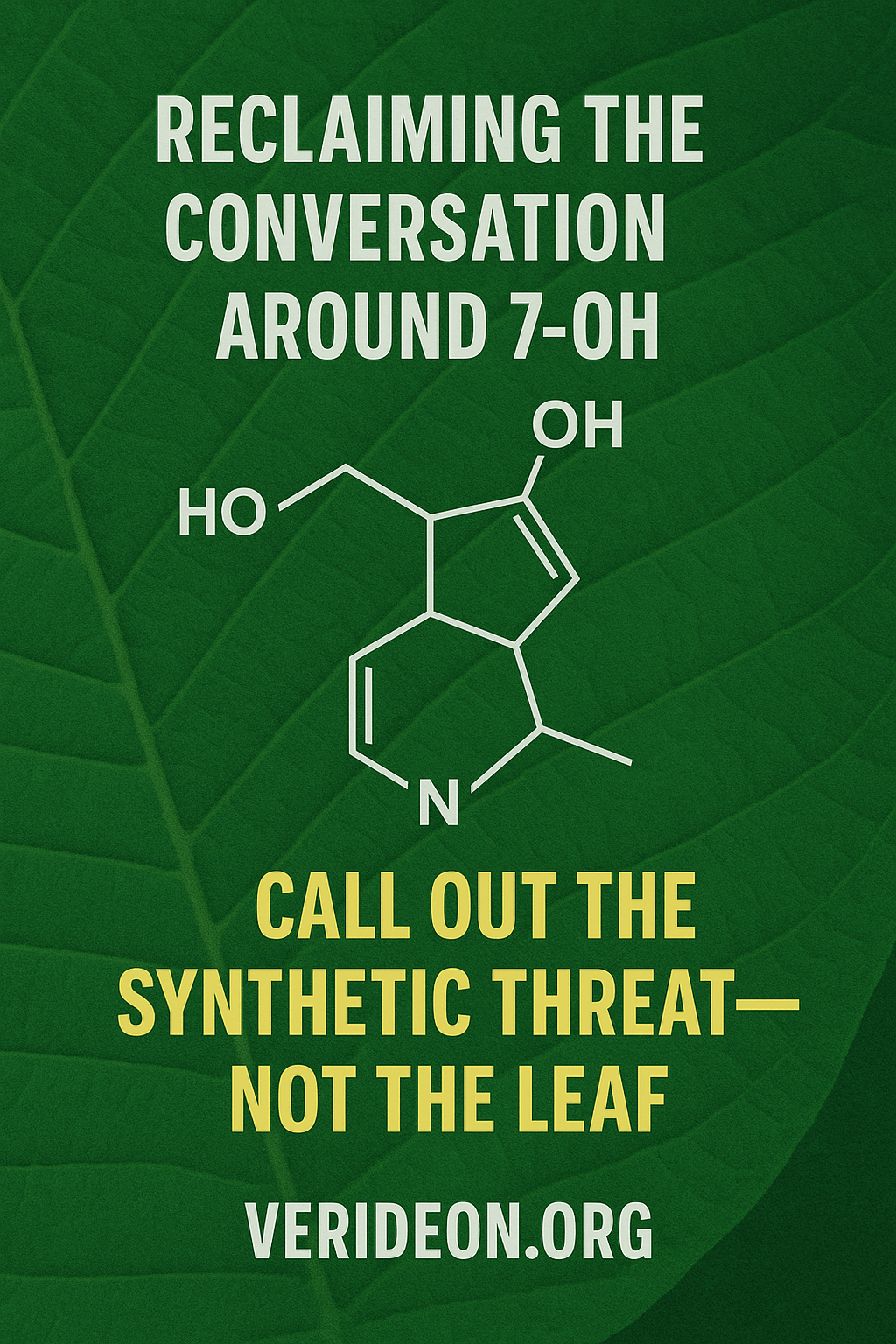
Reclaiming 7-OH: Ending the Demonization of Kratom’s Most Misunderstood Alkaloid
-

Synthetic Imitations, Real Risks: What You Need to Know About Semi-Synthetic 7-OH Products
Not all “Kratom” is what it claims to be.
In early 2025, a research team including Dr. Christopher McCurdy—one of the most respected scientists in the Kratom field—published a warning in the journal Addiction about a rising threat to consumer safety: the emergence of semi-synthetic 7-hydroxymitragynine (7-OH) products being sold under the Kratom name.
What’s the Big Deal?
Naturally, 7-OH exists in Kratom in very small amounts. It’s one of the plant’s most potent alkaloids, with 14 to 22 times the mu-opioid receptor binding affinity of morphine. But in its natural form—alongside over 40 other alkaloids—it’s balanced by nature.
These new products?
They’re not balanced. They’re engineered.
What’s Being Sold?
Researchers identified novel products like:
Sublingual tablets
Nasal sprays
Capsules containing up to 98% 7-OH
Some single doses contain 14–25mg of pure 7-OH—compared to the micrograms present in natural Kratom. And with delivery methods that bypass digestion, they hit harder, faster, and more unpredictably.
Why Should You Care?
Because these products are being sold under the Kratom label.
That means people might think they’re taking regular, leaf-based Kratom—when in reality, they’re consuming something far more potent, far less studied, and potentially dangerous.
The authors of the study highlighted several serious concerns:
High potential for abuse and dependency
No human or animal safety data
No labeling or consumer warning
Regulatory confusion and gray market risks
This Isn’t Traditional Kratom
This isn’t the cup of tea many people rely on for managing chronic pain, stress, or focus. This is chemistry that mimics one part of Kratom while removing the balance that nature built.
The danger here isn’t just about the synthetic alkaloids—it’s about misleading consumers, damaging public trust, and handing fuel to those who want Kratom banned altogether.
Verideon’s Stance
We believe in transparency, education, and safe, natural products. We don’t support the sale or promotion of semi-synthetic 7-OH disguised as “Kratom.” Consumers have a right to know what they’re putting in their bodies—and to choose whole-plant products that have centuries of traditional use behind them, not mystery compounds with no safety data.
If you want to read the original study, here it is:
The Rise of Novel, Semi-Synthetic 7-Hydroxymitragynine Products
This is your leaf, your choice. Let’s keep it that way—by staying informed, speaking up, and holding companies accountable for the truth.
 Verideon